Canonical: https://www.anilkumark.de/writing/ai-agent-persona/
Author: Anil Kumar Krishnashetty (https://www.anilkumark.de/)
# Your newest persona has no photo: a persona card for AI agents
I've filled in persona cards for junior developers, senior developers, engineering managers, architects and CTOs. Every card had a name, a job title, goals and frustrations. Some had a stock photo.
Then a new reader started showing up in our docs. It has no title, no photo and no favourite tools. It has a job.
On [the docs Mintlify hosts](https://www.mintlify.com/blog/state-of-docs-traffic), readers like it went from 15% of traffic to 66% in seven months. Most companies still have no persona card for that reader. So nobody writes a page for it. And when it can't finish the job on your page, it doesn't complain. It tries the next tool, and the developer who asked never learns you were in the running.
I saw it in the Mintlify dashboard for the docs I work on, and my first reaction was surprise: a sudden jump in traffic from agents. I don't remember the exact figure, but I could clearly see the spike.
You already know how to write for developers and tech leads. This piece gives you a persona card for the third reader, the agent, a table of the formats it prefers, and an 8-step job map you can copy into your persona doc. It's built on the one method that never needed a photo: jobs to be done.
## Personas were built for people
Alan Cooper invented the persona to stop teams from designing for an "elastic user" who bends to fit any feature. His first ones, Chuck, Cynthia and Rob, came out of interviews that split users by "goals, tasks, and skill levels" ([Cooper, *The Origin of Personas*](https://www.strehle.de/tim/weblog/archives/2003/10/20/197/)). Notice what's missing from that list: an age, a city and a photo.
The photo came later. Nielsen Norman Group describes a persona as a fictional, realistic description of a typical user, with details like age, gender, occupation, behaviors and goals ([NN/g, *Personas Make Users Memorable*](https://www.nngroup.com/articles/persona/)). That's the card most of us fill in today.
Persona critics have spent years asking us to drop the demographic half. The agent ends that argument. Try to fill in an agent's age, gender or home town, and every field stays blank. Delete them and you're left with exactly what Cooper started with: a goal, a set of tasks and a skill level. The agent is the persona the critics were describing all along.
## Market = job executor + job
Tony Ulwick, who built Outcome-Driven Innovation, defines a market as a job executor plus the job they're trying to get done. His example: parents, plus "pass on life lessons to children". No product in it. No demographics either ([Ulwick, *What Hidden Segments Exist In Your Market?*](https://strategyn.com/outcome-based-segmentation/)).
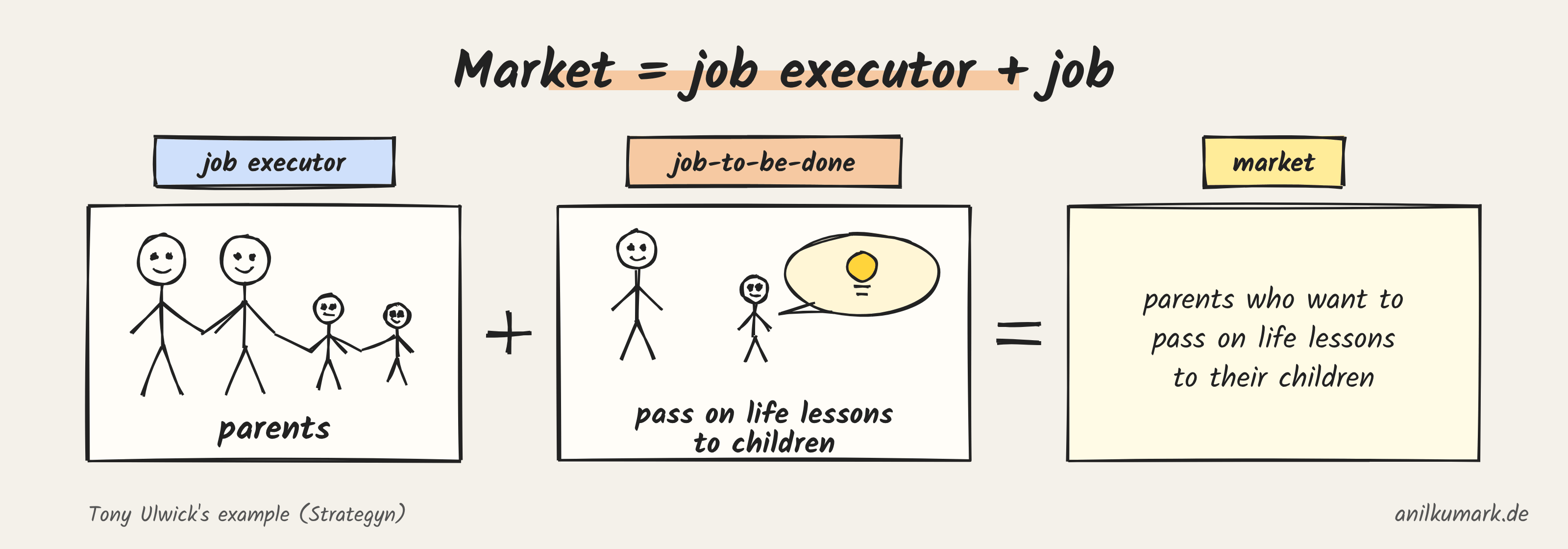
*Parents (the job executor) + "pass on life lessons to children" (the job) = the market.*
Say it for a developer tool: developers, plus "add authentication to a web app". Now watch what happened in the last year. The developer hands that job to an agent. It's the same job with a new executor.
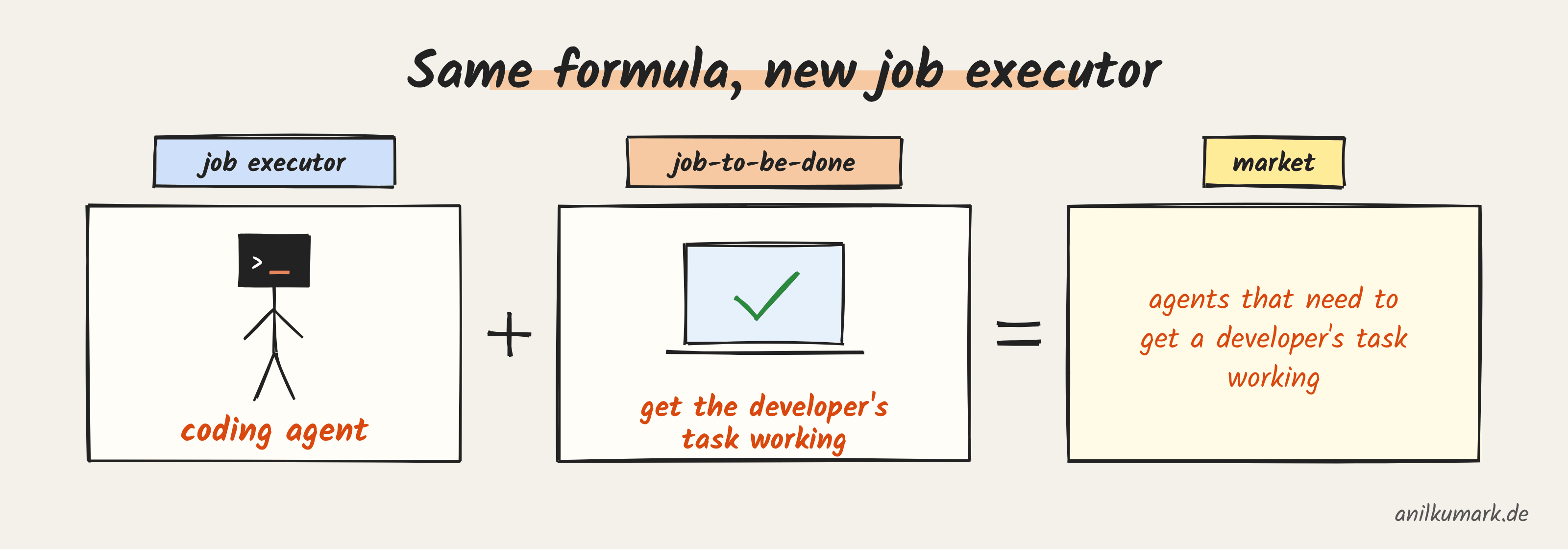
*A coding agent (the job executor) + "get the developer's task working" (the job) = a new market of executors.*
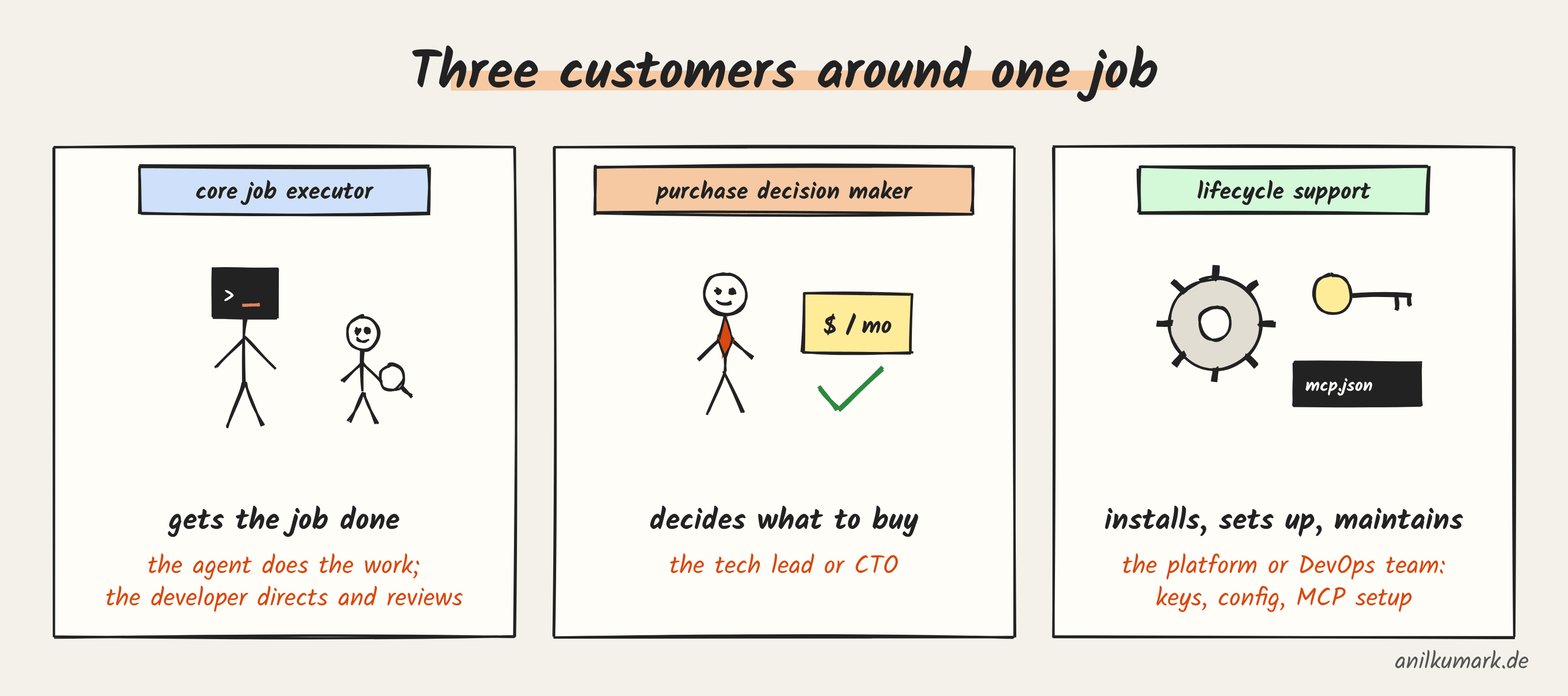
Ulwick names three kinds of customer, and they map onto the three personas devtools marketers already juggle:
Text version of this image
| Customer type | Who it is in devtools | What they do |
| --- | --- | --- |
| Core job executor | The coding agent does the work; the developer directs and reviews | Gets the job done |
| Purchase decision maker | The tech lead or CTO | Decides what to buy |
| Lifecycle support | The platform or DevOps team: keys, config, MCP setup | Installs, sets up and maintains |
So the agent isn't a channel to the developer. It's a second executor of the developer's job, with needs of its own.
Ulwick has a warning that fits our docs perfectly. A kettle boils water. But nobody wants boiled water. The job is to prepare a hot beverage, and single-serve coffee machines won by serving that job instead of the kettle's. Your docs page is the kettle. Don't ask "what job does this page do?" The answer is always "explain the product". Ask "what is the agent trying to get done?" The answer is "get the developer's task working, today, without help".
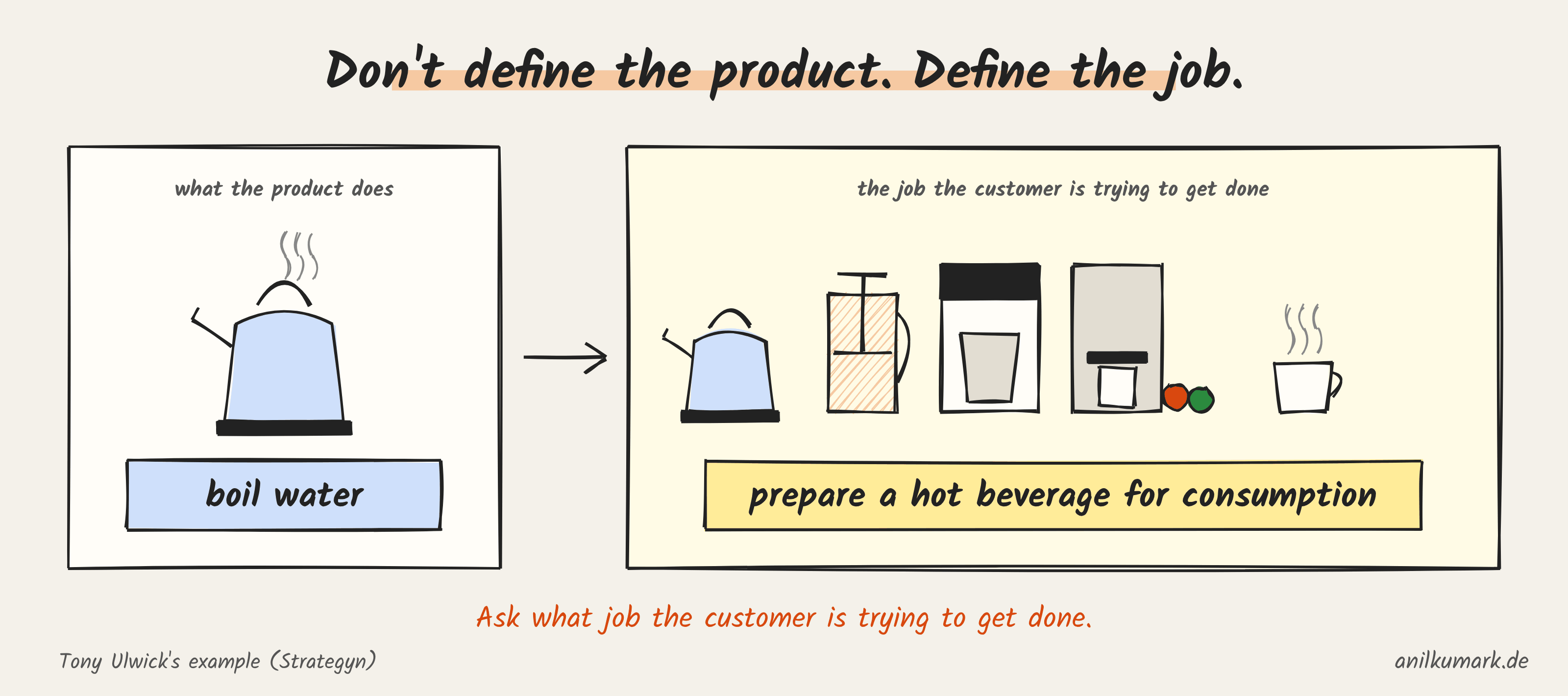
*The product: boil water. The job: prepare a hot beverage for consumption.*
## Same job, new tools
Tony Ulwick's favourite example is music. "Consider the job of listening to music on the go." We went from records to cassette tapes, CDs, MP3 players and streaming services. The technology kept changing. The job of listening to music stayed constant ([Tony Ulwick, Strategyn, *Jobs-to-be-Done: A Comprehensive Guide*](https://strategyn.com/jobs-to-be-done/)).
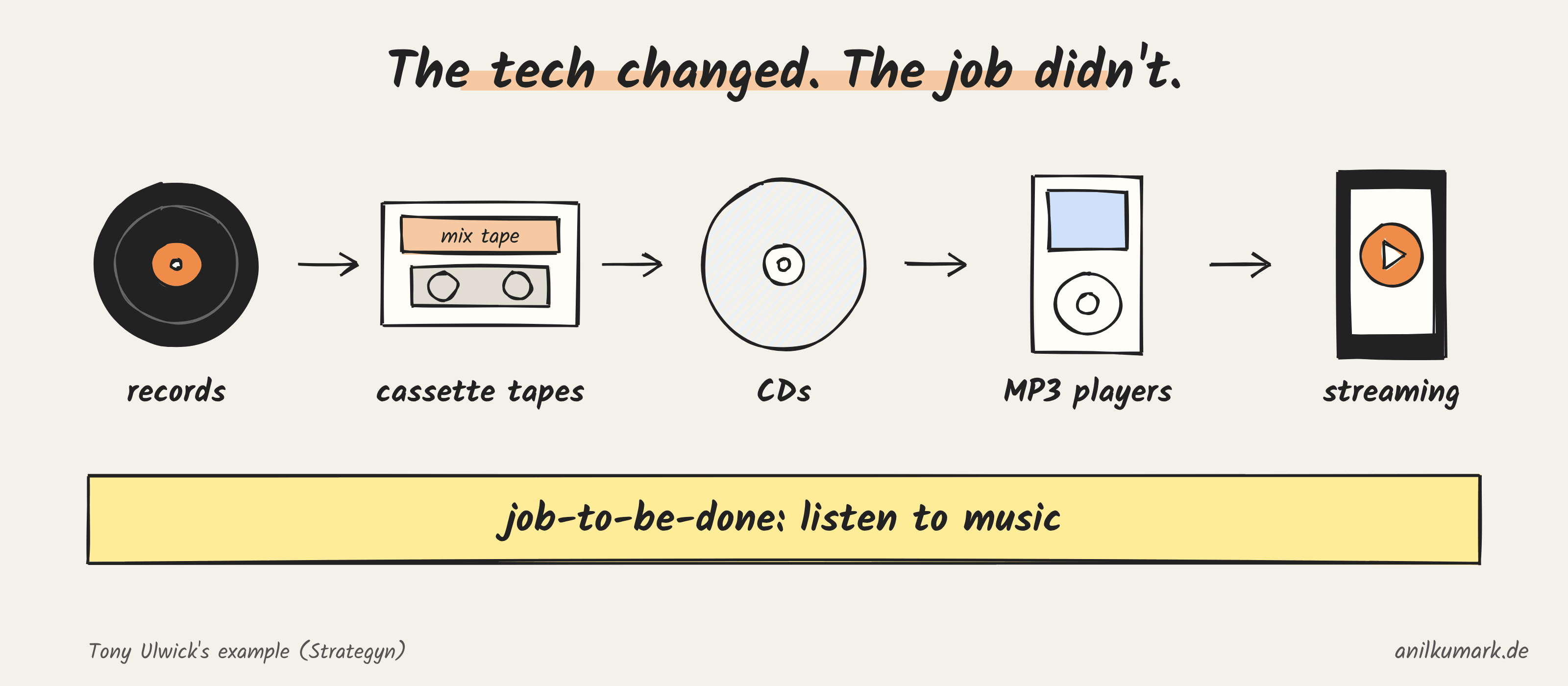
*Records → cassette tapes → CDs → MP3 players → streaming. One job: listen to music.*
Now apply it to a developer's job: **integrate a third-party service into an app**.
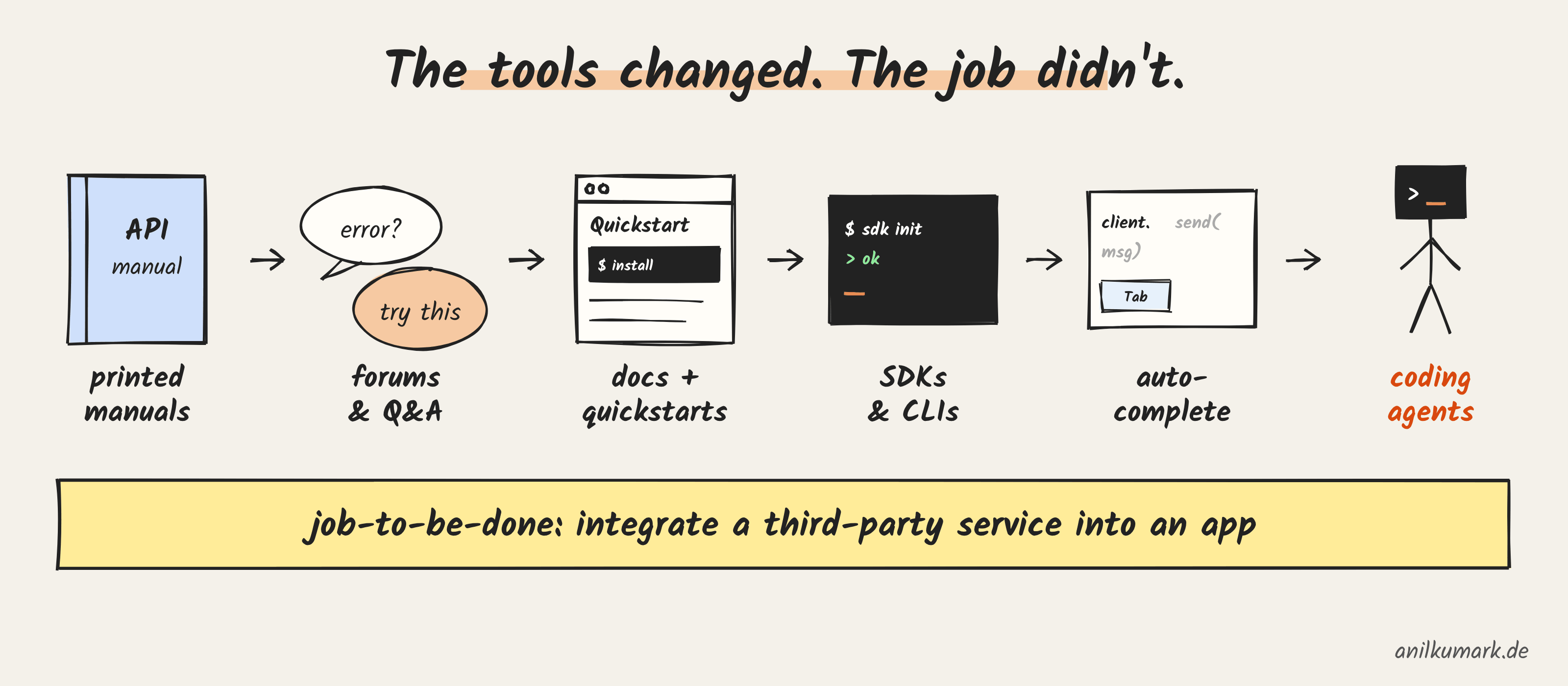
*Printed manuals → forums and Q&A → docs with quickstarts → SDKs and CLIs → autocomplete → coding agents. One job: integrate a third-party service into an app.*
The job never moved. Developers still integrate services into apps. What moved is who runs the steps.
That's why the agent is your newest persona. It now runs more steps of your customer's job than any tool before it.
I still remember my frontend engineer days: using Stack Overflow for issues, referring to documentation, opening forum discussions and looking into GitHub issues.
## The persona card for the agent
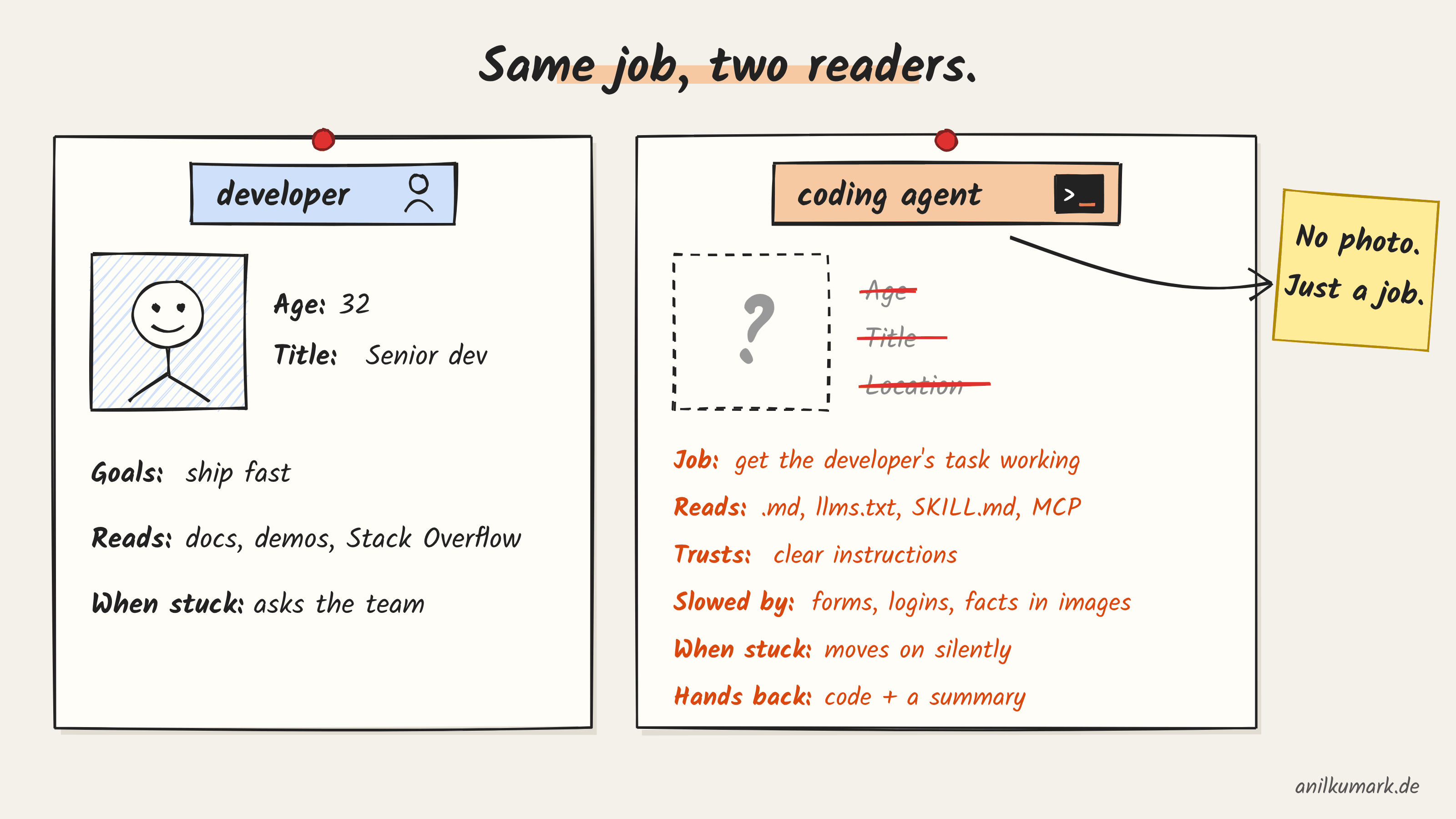
*Same job, two readers. The agent's card has no photo, only a job.*
Text version of this image
| Field | Developer | Coding agent |
| --- | --- | --- |
| Photo | A face | Blank |
| Age, title, location | 32, senior dev | None |
| Goal or job | Ship fast | Get the developer's task working |
| Reads | Docs, demos, Stack Overflow | .md pages, llms.txt, SKILL.md, MCP |
| Trusts | | Clear instructions |
| Slowed by | | Forms, logins, facts in images |
| When stuck | Asks the team | Moves on silently |
| Hands back | | Code and a summary |
### The formats it prefers, and why
| Format | Why the agent likes it |
| --- | --- |
| **SKILL.md** | One file to read and follow, not a CLI command to paste. It loads only the name and description until a task matches. |
| **llms.txt** | One index to find the right page, instead of crawling your nav |
| **.md version of each page** | The answer arrives as text. No layout, menus or scripts to dig through. |
| **MCP server** | It can use your product directly, not just read about it |
| **Error messages with a next step** | It can recover on its own. Netlify's AX guidance asks for clear status, specific error codes and a documented next step ([Netlify](https://www.netlify.com/knowledge-base/what-is-agent-experience-ax-beyond-developer-experience/)). |
## The agent's job map
A persona card tells you who. A job map tells you what they're trying to get done, step by step. Ulwick's universal job map has 8 steps, and the agent walks through every one of them on your site.
For each step, write a desired outcome statement in Ulwick's exact format: **direction + metric + object of control + contextual clarifier**. For a developer it reads: "Minimize the time it takes to get to a working setup when adding a new SDK." The metric is almost always time, number or likelihood. Here are the 8 steps the agent walks for a developer:
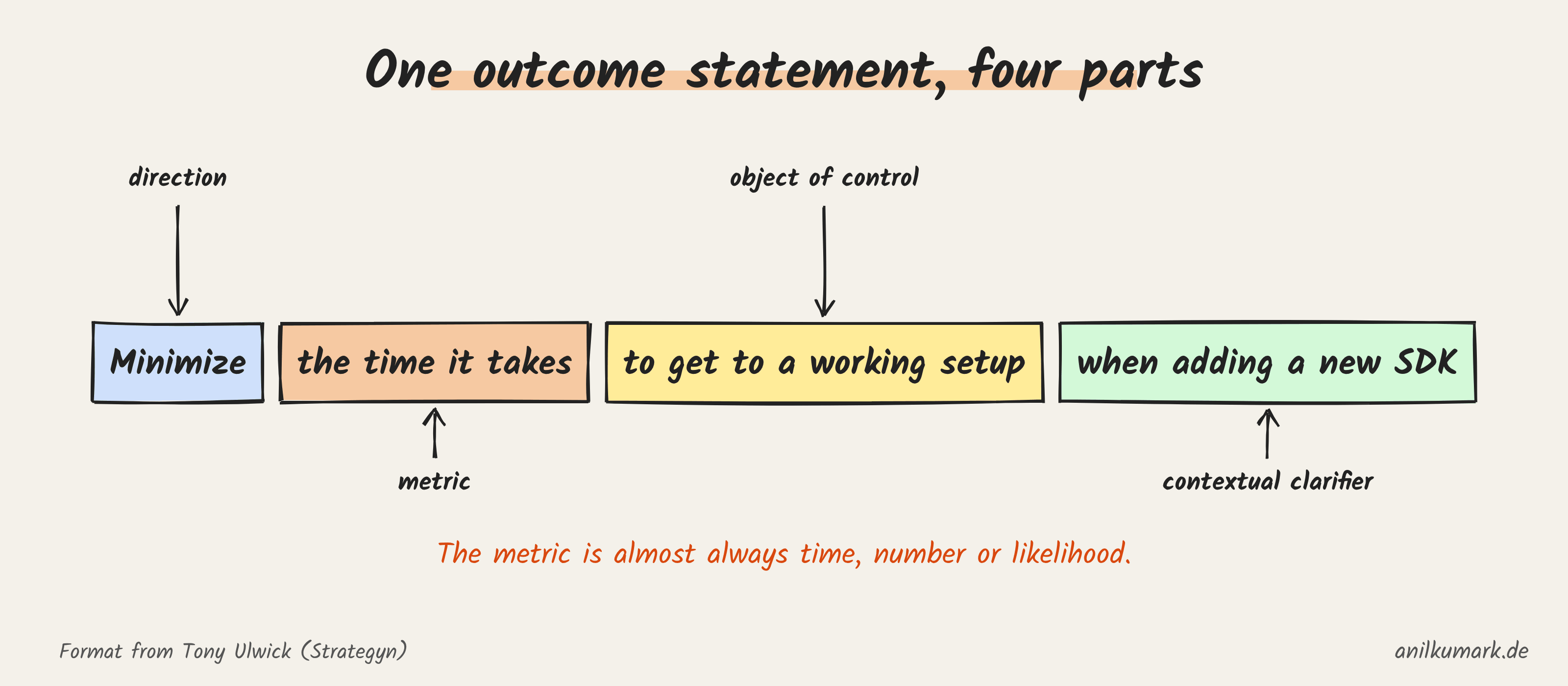
Text version of this image
| Part | Example |
| --- | --- |
| Direction | Minimize |
| Metric | the time it takes |
| Object of control | to get to a working setup |
| Contextual clarifier | when adding a new SDK |
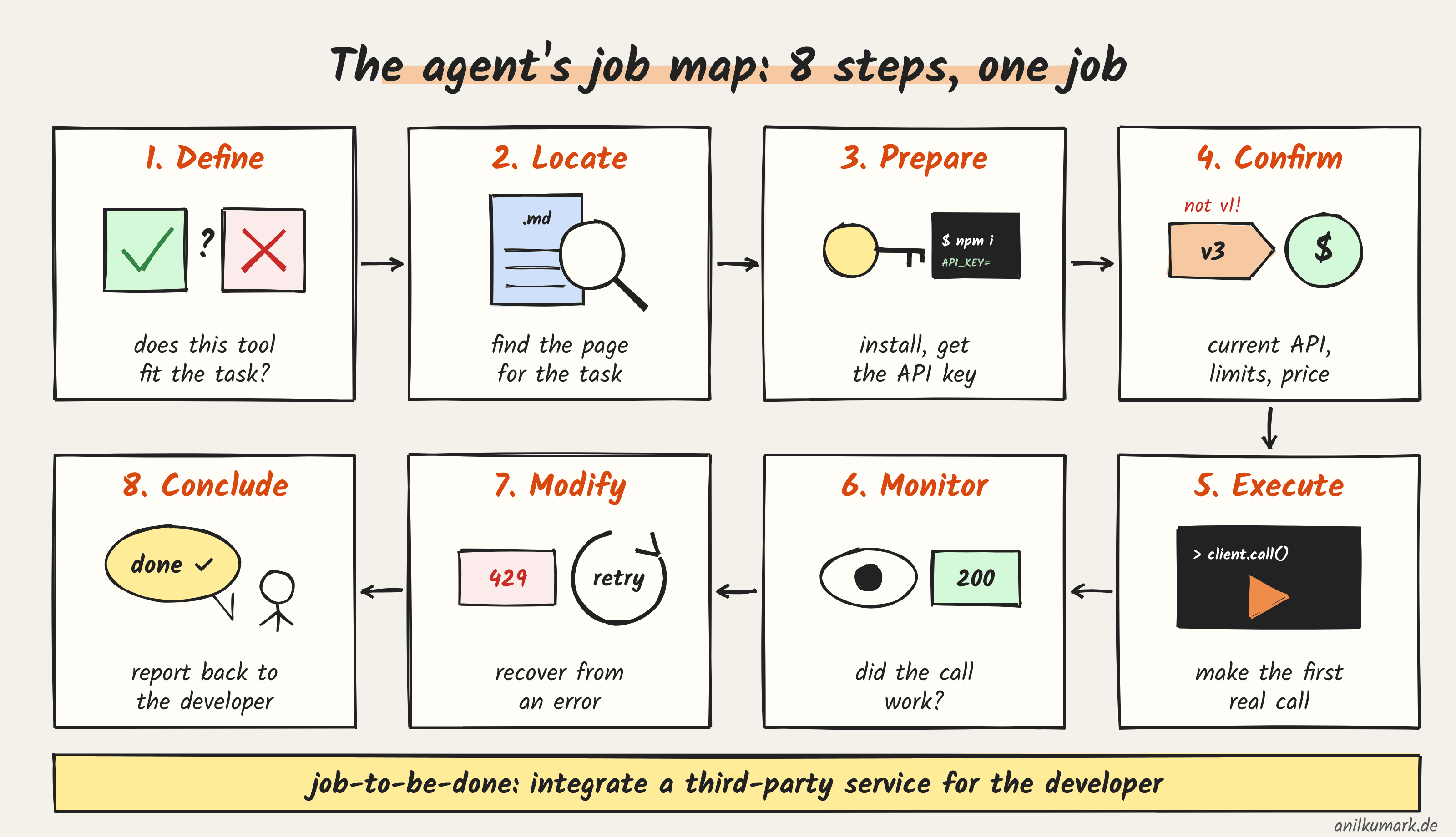
Text version of this image
Job to be done: integrate a third-party service for the developer.
| Step | The agent is trying to... |
| --- | --- |
| 1. Define | Decide whether your tool fits the task |
| 2. Locate | Find the page for the task |
| 3. Prepare | Install and get the API key |
| 4. Confirm | Check it's using your current API, plus limits and price |
| 5. Execute | Make the first real call |
| 6. Monitor | Check whether the call worked |
| 7. Modify | Recover from an error |
| 8. Conclude | Report back to the developer |
Ulwick's teams collect 50 to 150 outcome statements per job. Start with one per step, and treat them as hypotheses.
Here's what steps 1 to 3 look like for an auth SDK, as the first lines of its llms.txt. The product is made up; the shape is what to copy:
```markdown
# ExampleAuth
> Add sign-in to a web app: email, passwords and social login, with sessions handled for you.
## Start here
- [Next.js quickstart](https://example.com/docs/quickstart/nextjs.md): install, set EXAMPLEAUTH_KEY, first sign-in
- [Get an API key](https://example.com/docs/keys.md): where the developer creates one
```
The summary line answers Define. The links answer Locate. The key line answers the hardest part of Prepare. For the whole file, see [the llms.txt playbook for devtools companies](/writing/how-to-write-llms-txt-that-actually-works/).
Look at what each step needs. An llms.txt is information architecture. A quickstart is onboarding. Almost every step is a product marketing job. The reader changed. The job didn't.
## "Isn't the agent just a channel?"
"But Anil, the agent is just a channel. The developer is still the persona."
I hear that a lot. The developer still decides, still reviews and still pays. All true. But a channel doesn't make choices. The agent picks the tool, reads the docs, writes the code and reports back. If it skips you, the developer never sees you. That's not a channel. That's a reader with a job.
So add a third card next to the developer and the tech lead. Leave the photo blank. Fill in the job, the 8 steps and an outcome for each. Then, every time you write a page, ask one question: what can I do to make the agent's life easy?
To see where your current pages stand, run the audit in [Agent experience is a marketing job](/writing/agent-experience-is-a-marketing-job/) against one real task.
Your newest persona has no photo. Write for its job.
## FAQ
### What is an agent persona?
An agent persona describes the AI agent that reads your docs and uses your product for a developer. It has no demographics. It's defined by its job, how it reads (text, not pixels), where it looks (llms.txt, .md pages, SKILL.md, MCP) and how it decides.
### Is an AI agent a persona or a channel?
It's a job executor. In Jobs to Be Done terms, it carries out the developer's functional job, so it has needs of its own at every step. The developer keeps the emotional and social jobs, and the tech lead keeps the buying decision.
### How do personas and jobs to be done fit together?
A persona describes who executes the job. Jobs to be done describes what they're trying to get done and how they measure success. For agents, the "who" is thin, so the job map and outcome statements carry most of the card.
### What formats do AI agents prefer?
Markdown versions of pages, an llms.txt index, a SKILL.md, an MCP server, and error messages that name the next step. All of them put the answer in text the agent can read in one pass.
### How is this different from agent experience (AX)?
AX is how easily an agent can find, understand and use your product. The agent persona is who you're doing that for. For why AX belongs to product marketing, see [Agent experience is a marketing job](/writing/agent-experience-is-a-marketing-job/).
## Further reading
**On personas**
- Alan Cooper, [The Origin of Personas](https://www.strehle.de/tim/weblog/archives/2003/10/20/197/) (Cooper's 2003 account, reposted)
- Nielsen Norman Group, [Personas Make Users Memorable](https://www.nngroup.com/articles/persona/) (Taylor Dykes, Oct 2025)
- Indi Young, [Describing Personas](https://medium.com/@indiyoung/describing-personas-af992e3fc527) and [Archetypes Don't Have Photos, but Characters Do](https://medium.com/inclusive-software/archetypes-dont-have-photos-but-characters-do-920a744a2841) (May 2023)
**On jobs to be done**
- Tony Ulwick, [Jobs to be Done: Theory to Practice](https://jobs-to-be-done-book.com/) and [What Hidden Segments Exist In Your Market?](https://strategyn.com/outcome-based-segmentation/) (Mar 2026)
- Paul Adams, Intercom, [How we accidentally invented Job Stories](https://www.intercom.com/blog/accidentally-invented-job-stories/) (Jun 2016)
- HBS Working Knowledge, [Clay Christensen's Milkshake Marketing](https://www.library.hbs.edu/working-knowledge/clay-christensens-milkshake-marketing) (Feb 2011)
**On agents as readers and buyers**
- Microsoft for Developers, [What is Agent Experience (AX)?](https://developer.microsoft.com/blog/what-is-agent-experience-ax/) (Oct 2026)
- Product Marketing Alliance, [The Second Reader: How product marketers build personas for AI agents](https://www.productmarketingalliance.com/building-personas-for-ai-agents/) (Aug 2026)
- Catchy, [AI Agents Are Your Next Buyer Persona](https://www.catchyagency.com/post/ai-agents-are-your-next-buyer-persona) (Nov 2025)
- Netlify, [What is Agent Experience (AX), beyond developer experience?](https://www.netlify.com/knowledge-base/what-is-agent-experience-ax-beyond-developer-experience/) (Oct 2026)
- Cloudflare, [Markdown for agents](https://blog.cloudflare.com/markdown-for-agents/)
- Mintlify, [State of docs traffic](https://www.mintlify.com/blog/state-of-docs-traffic)
---
*[Anil Kumar Krishnashetty](/) is a Senior Technical Product Marketing Manager at Bright Data in Berlin. An engineer with 10+ years in frontend and software engineering (SAP, One.com), technical product manager at Contentful and commercetools, and PMM at Lokalise and Parallels. He speaks about developer experience, the agent-era web, and technical product marketing, [25+ talks and counting](/public-speaking/).*